
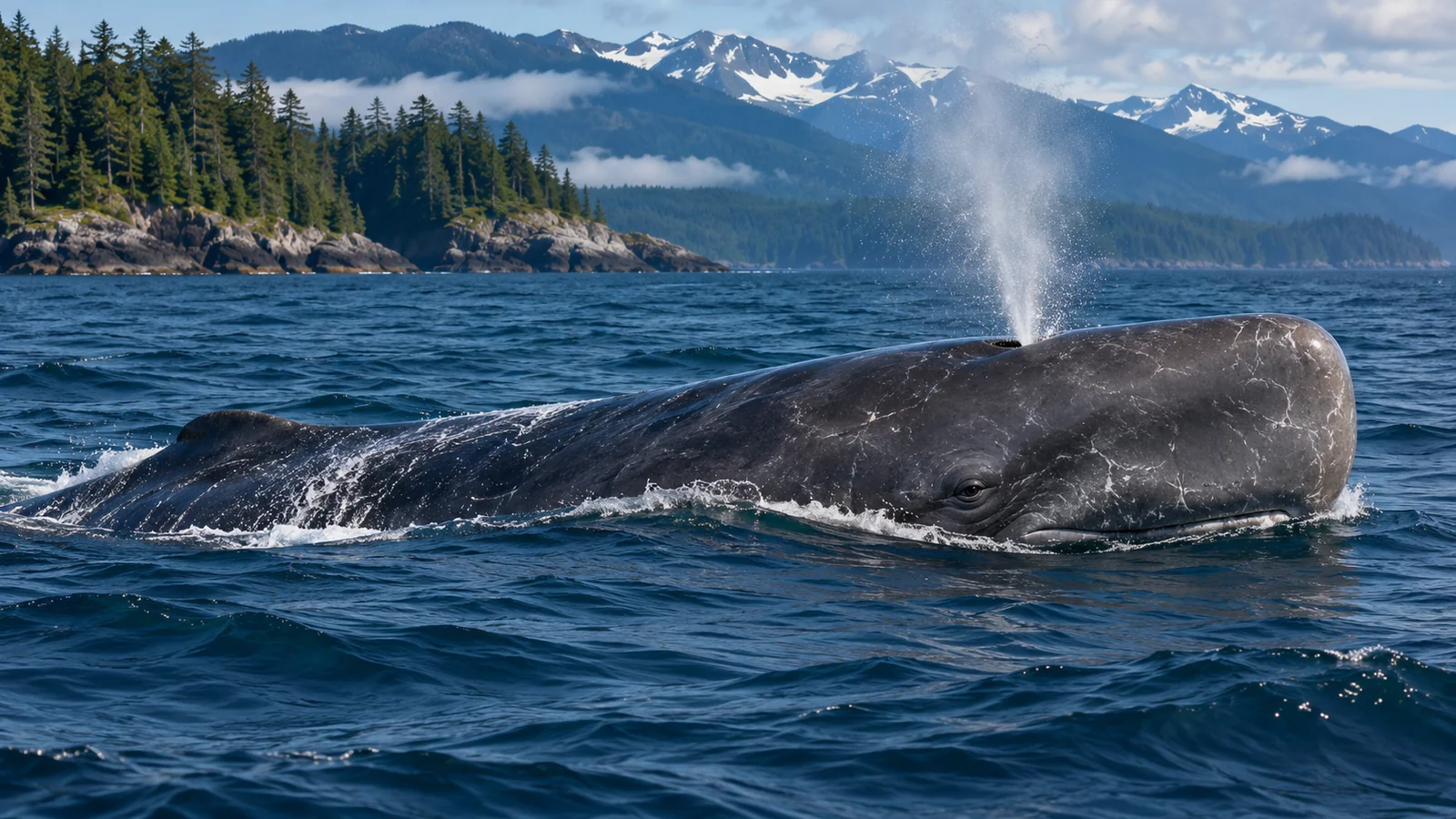
Sperm whales often use deep offshore waters because much of their prey lives well below the surface. They dive in search of squid and fish and use echolocation to locate prey in water where little light penetrates. A steep continental slope or underwater canyon can put deep habitat close to the coast, while a broad, shallow shelf places comparable depths much farther offshore. Distance from shore is therefore only a rough clue. For a British Columbia traveller, the distinction helps explain why sperm whales are part of the province’s marine fauna while remaining an uncommon encounter on inshore trips.
Read the shape of the seafloor
A map can show how quickly the bottom drops away from land. Across a continental shelf, depths generally increase more gradually. Along a continental slope the bottom descends more steeply toward much deeper water. Canyons and banks can make that pattern more complicated. A place close to a steep drop-off can give a whale access to deep water without the animal being a great horizontal distance from shore. The kind of habitat matters more than the distance alone. Washington Department of Fish and Wildlife sperm whale profile
Even a detailed depth chart leaves questions about where prey occur. Some animals live or move in layers well above the bottom. Others are associated with deeper habitat closer to the seafloor. A sperm whale can move through several of those layers during a dive. If a study describes a whale over water a certain depth, check whether it measured how far the animal actually descended. Seafloor depth and diving depth describe different things. Research on sperm whale foraging dives
The same distinction applies to a map of sightings. A point shows where a whale or a group was recorded. It may come from a surfacing after a dive. If researchers want to know which depth was used for foraging, they need more evidence about the whale’s activity underwater. A map can help them locate the encounter in relation to the continental slope without explaining the whole dive.
What sperm whales find in the deep
Sperm whales are toothed whales that feed heavily on squid and also take fish. The exact mix can vary across areas and animals. Deep water contains many potential prey species, and an individual whale may encounter several in one dive. The existence of very large squid in the ocean is a memorable part of the species’ public image. A useful account of the diet also considers the other squid and fish available where the whale is feeding. NOAA sperm whale profile
The food is distributed unevenly. A whale may search a wide area before encountering a promising layer, then change direction or continue searching at another depth. Scientists can investigate these patterns using records of both movement and sound. Where the whale speeds up or changes course, a sound record can help show whether that movement occurred during an apparent search or a closer approach to prey. The exact prey species may still be uncertain.
There is also a difference between a prey layer and a particular animal within it. Finding signs of many potential prey helps a sperm whale decide where to search. Capturing food requires the whale to detect and approach individual targets. Echolocation can provide information at both scales. A study that describes a dense group of echoes may tell you where organisms were present. A sequence tied to a whale’s changing clicks and movements can provide more detail about how it pursued something within that area. Research on sperm whale long-range echolocation
How echolocation helps on a dive
A sperm whale can produce clicks and listen for echoes from objects and organisms around it. Those echoes can provide information about where potential prey are. Researchers studying feeding dives have recorded patterns of regular clicks while whales search and much more rapid sequences as they close in on targets. The rapid sequences are often called buzzes or creaks. Scientists can compare when those sounds occur with a whale’s depth and movement.
A buzz is evidence of a stage in the pursuit. It can indicate a possible capture attempt without showing whether the target was caught or swallowed. Researchers have used records of clicks, echoes and changes in motion to investigate the chase in more detail. A single sound can give one part of the sequence. A stronger interpretation comes from seeing how several kinds of evidence line up. Research on sperm whale prey pursuit
Sperm whales also make sounds in other settings. A person hearing an unfamiliar recording may need the context of the animal’s movements and the type of clicks to understand why the sound matters. A field recording of clicks used during a deep dive can help researchers ask about feeding. A recording of whales at the surface can raise other questions about the social context. Read the description of what was recorded before treating every sperm whale click as evidence of the same behaviour.
Follow the dive from the surface to depth and back
A whale at the surface is breathing air. During a foraging dive, it descends, spends time searching or pursuing prey and then returns to breathe again. Its large capacity to carry and use oxygen during a dive helps make this cycle possible. The amount of time spent in each part can vary with the depth of prey and the whale’s behaviour. Records from an animal-borne tag let scientists distinguish the surface interval from the periods of descent, searching and ascent.
From a vessel, observers might see several breaths and then the tail lift as a whale starts a deep dive. The surface sequence shows that it changed posture and submerged. It cannot show the route it took beneath the boat, the depth at which it searched or the prey it encountered. An observer who knows the time of the dive can make a useful record by noting how long the whale was out of view and whether it was identified on its next surfacing.
Surface intervals help explain why animals can be present in deep waters without appearing often to a visual observer. A survey might pass through an area while nearby whales are all below the surface. An underwater recording could still detect clicking animals, if they vocalise within range of the equipment. The two observations cover different parts of a dive cycle. Combining them can give a fuller account of where and when sperm whales used the area.
What the Canadian Pacific records show
Fisheries and Oceans Canada includes the sperm whale in its guide to cetaceans found off British Columbia. The agency has also documented the species in reporting on Pacific Canadian cetacean surveys. These are useful places to start if you want to know whether sperm whales occur in the region. Compare the study area with the coastline in a tour description. Survey teams may cover open ocean and slope habitat well beyond the channels that an inshore passenger trip uses. DFO’s guide to cetaceans of British Columbia · DFO’s Pacific Canadian cetacean survey report
Regional distribution also varies among animals. In the species generally, adult males range into higher latitudes than many groups of females and young. A record from one latitude can reflect the distribution of a particular part of the population. If a survey recorded several males in higher-latitude offshore waters, its results would say more about that group than about where calves are commonly found. Keep the age and sex information when a source supplies it.
British Columbia’s outer coast and its inland waterways also provide very different observing settings. Deep offshore habitat is the better place to look for context on typical sperm whale foraging. An unusual inshore report can still be real. Its location is one reason it may be noteworthy. An isolated record gives a reliable place and time if the identification is sound. A consistent regional pattern requires a wider body of evidence.
How to interpret a record made far from shore
Start with the type of observation. A vessel survey may record an animal when it breathes or lifts its tail. A hydrophone can detect clicks from animals out of sight. An animal-borne tag can record detailed movements and sounds from one individual for a limited period. In each case, ask what the observation confirms. A surface record might support a species identification, while a tag record can support an interpretation of repeated deep foraging dives.
Then check the date range and habitat covered. A survey may visit some areas frequently and sample others only when conditions allow. The number of records in deep water can reflect both where whales spend time and where surveys were able to look or listen. Researchers compare effort and methods when they want to estimate how animals are distributed. A traveller reading a single encounter report can still learn where the whale was observed without using it as a forecast.
A chart of detections also needs a legend. Several clicks could come from one whale, and a period without clicks could reflect silence or movement outside the listening range. A line on a dive profile usually represents a series of measured or estimated depths, which is a different kind of evidence from a dot on a map. If the study calls a sequence a possible capture attempt, preserve that wording when describing what the whale did.
What this means for a Campbell River trip
A Campbell River whale watching trip is an opportunity to learn about the marine habitat and wildlife of the waters the crew visits. The offshore habitat preferred by sperm whales is useful regional context. It gives you a reason to ask how the animals you do see use the water column differently. A humpback lunging into a patch of small fish and an offshore sperm whale seeking squid both find food that is concentrated unevenly, using different feeding anatomy and behaviour. Eagle Eye’s guide to marine wildlife on whale watching tours
If a guide mentions an unusual whale record, ask what details supported it. A photograph, location and observation method can put the report in context. Choose an outing around its departure details and the wider experience you want. You can learn about deep-diving whales without expecting the crew to find one on an inshore route. Eagle Eye’s Campbell River whale watching tour
Frequently asked questions
Do sperm whales live only in the open ocean?
They commonly use deep oceanic habitat and can also occur where deep water approaches land. The shape of the seafloor and the availability of prey help explain their distribution.
Do all sperm whales dive to the same depth?
Depth varies among dives and places. Look for the animals studied, where their dives were recorded and what evidence researchers used to identify the foraging phase. One figure can describe a particular set of dives without representing every individual.
Can you tell which prey a sperm whale caught from its clicks?
The pattern of clicks can help identify searching and apparent capture attempts. More evidence is needed to identify the prey or establish whether the attempt succeeded.
Are sperm whales found off British Columbia?
Fisheries and Oceans Canada includes them among the cetaceans of the province’s Pacific waters. Deep offshore habitat gives more context for understanding where they are normally encountered than a list of all species recorded in the province.
If you read an inshore sighting report, check whether it describes an identified animal in a sheltered channel or an encounter farther out near a steep drop-off. Both may be referred to by the name of the nearest community. A chart showing the encounter location in relation to the seafloor gives you more information about the habitat than the town name alone.