
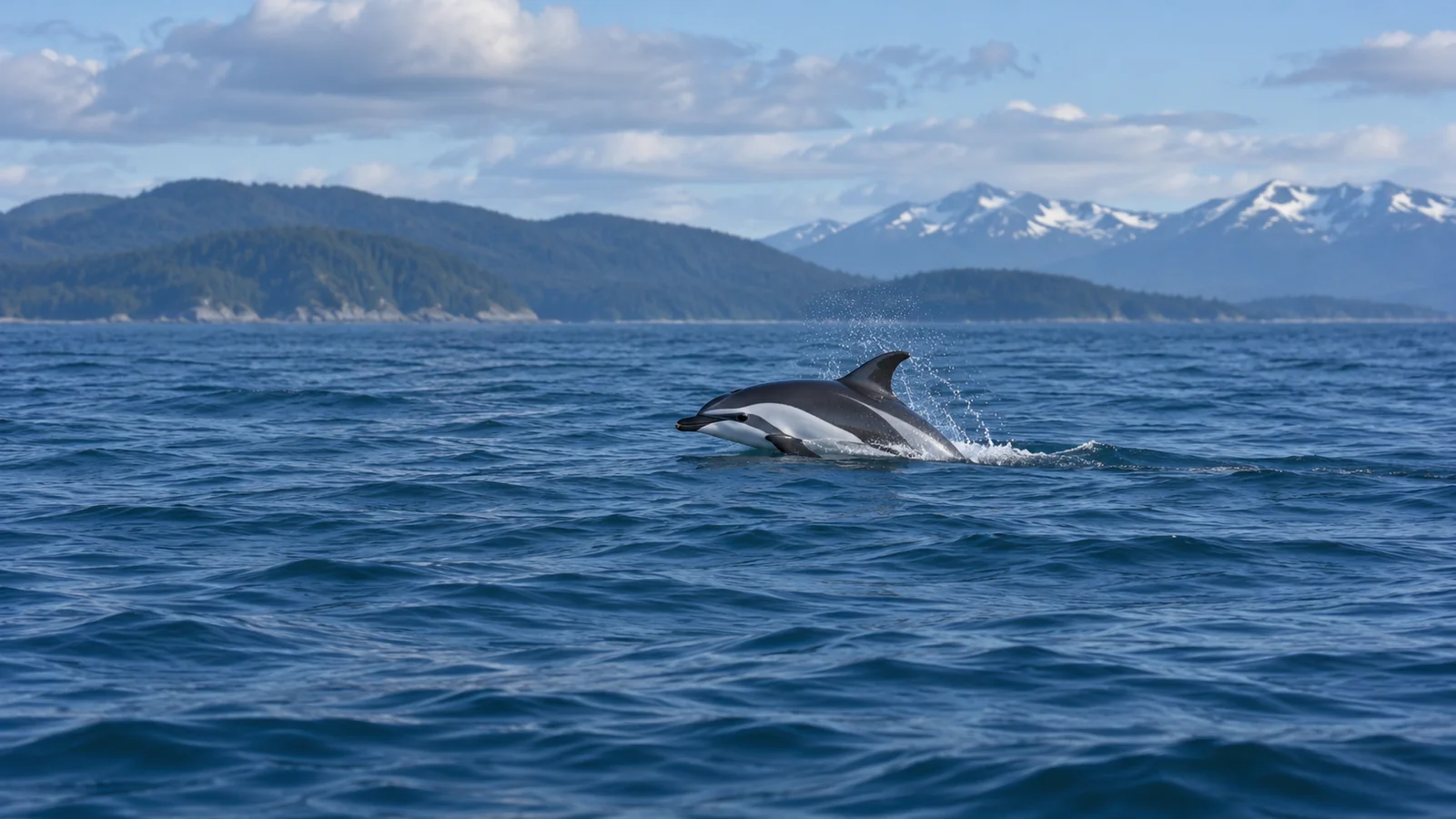
Pacific white-sided dolphins sometimes swim in the pressure wave at the front of a moving boat. The wave can help a dolphin maintain its position relative to the bow with less swimming effort. Researchers have found evidence of that benefit in another dolphin species, the dusky dolphin. For a Pacific white-sided dolphin you see in British Columbia, the pressure wave explains how the ride works, while the reason the individual joined the boat can remain uncertain. An animal may approach and depart quickly. It needs room to do both without a vessel trying to prolong the encounter. NOAA Fisheries Pacific white-sided dolphin profile Dusky dolphin bow-riding study Marine Education and Research Society boating guidance
If you’ve watched dolphins travel across a channel, you may have seen several surface ahead of one another in the direction the group is moving. At a bow, the reference point changes. For a moment the same individual appears to hold a spot relative to the front of the boat. That detail is easier to remember after a sighting than the size of the group or how many times each animal surfaced.
What the bow wave does
As a vessel moves, its hull displaces water. The wave at the front is associated with a change in pressure and movement of water. A dolphin that occupies part of this moving wave can receive forward assistance from it. From the deck, that may look like a dark back holding a place alongside the bow or a body gliding just under the surface. The dolphin can still adjust its position and eventually swim out of the wave.
Compare two observations from the same deck. If a dolphin is swimming across the boat’s path, its position relative to the vessel shifts as the paths separate. If the dolphin is using the bow wave, its position relative to the hull may hold fairly steady for a time even as the animal and boat cover ground together. You may see the dark outline shift a little, then return to roughly the same position. A single frame of a dolphin near the front of a vessel could fit either scenario. The path over several seconds is the better clue.
The waves trailing a vessel are also part of the disturbance the hull leaves in the water. A dolphin behind the boat may be using the wake, while bow-riding refers to the front. People sometimes use the same word for both behaviours in conversation. If you’re trying to describe what happened, simply name the location and where the animal went. “Held a place by the front for a few seconds before turning away” is more precise than “dolphins followed us.”
What researchers could measure
A 2024 study off Kaikōura, New Zealand, compared freely swimming dusky dolphins with dusky dolphins bow-riding in front of a research vessel. The researchers used aerial video to follow individuals. They estimated speed and counted breaths over selected sequences. The comparison considered animals travelling at similar speeds in the two situations. At higher swimming speeds, the dolphins in the bow-riding sequences breathed less frequently than those swimming freely. The researchers used breathing rate as an indicator of energy expenditure.
The study offers a reason that wave assistance could matter to a swimming dolphin. The animal’s motion can look easy from above the surface, but a difference in breathing at similar travel speeds adds measurable evidence that the movement may cost less energy. The result comes from dusky dolphins under the observed conditions. The amount of energy a Pacific white-sided dolphin might save beside a different vessel in BC remains a separate question. There’s also a difference between energy use while an animal is in a wave and the energy cost of the full encounter. A dolphin may change course to enter a wave and travel away from where it started.
You can see why scientists made a comparison rather than relying on the apparent speed of one dolphin. An animal travelling faster may breathe differently because it’s going faster, regardless of where it is relative to the bow. A match on speed makes the two groups of observations more informative. A view from the deck can be enough to describe the animal’s position. For a comparison about energy use, the researchers needed a way to track swimming and breathing in both situations.
Why the animal might join and then leave
NOAA Fisheries describes Pacific white-sided dolphins as active, social dolphins that may approach boats and ride bow waves. A dolphin arriving beside a vessel can have different circumstances from the animals beside it. A group travelling through a channel may continue moving while a few individuals briefly use the wave. The departure may happen quickly enough that you lose track of where the group is. After a dolphin turns away, look back to the broader water rather than watching the same place by the boat.
Bow-riding can resemble play to a person watching, especially if individuals change places or repeatedly appear in the same stretch of water. Researchers have discussed play and travel efficiency as possible functions. A particular sighting gives you the position, movements and timing you can see. Motive takes more evidence. A dolphin gliding at the bow can use the wave’s assistance even if a different reason first brought it toward the boat. Likewise, the fact that a group approaches of its own accord tells you little about how it might respond to a vessel that changes its movement to try to attract it. Marine Education and Research Society boating guidance
A brief observation with a clear sequence can be more revealing than a longer view of a crowded patch of water. Try to remember what the group was doing before an individual appeared near the boat. After it left, could you see it rejoin other dolphins? Was the same animal visible throughout or did one dolphin vanish just before another came up? Those observations help describe an encounter without needing to settle what the animals intended.
Confirm what species you saw
Look for the combination of a short beak, an arched dorsal fin and contrasting light and dark areas along the side. The dorsal fin can have a two-tone appearance when the light is favourable. At the surface, a quick look may show only a curve of dark back or a flash of the paler underside. A clearer side view farther away can sometimes be more useful than a close view through foam. DFO Pacific cetacean identification poster
Dall’s porpoises can also approach a vessel and use its bow wave. The action near the boat therefore gives you a behavioural observation with limited identification value by itself. A Dall’s porpoise tends to have a more compact outline and a large pale patch low on the flank, with a triangular dorsal fin. For Pacific white-sided dolphins, look for the outline of the head and the pattern across the flank and fin together. If you had a view from straight above and the animal was gone before it surfaced again, “small cetacean” may be the strongest description your evidence supports.
What a passenger can do during an encounter
Follow the crew’s instructions and stay in a stable position. You can watch from the place you already have, even if it only gives you a momentary view. Give others room to see without crowding forward or leaning over the side. If a photo is possible from where you are, leave some space in the frame for the animal’s direction of travel. Photographs are optional, and a brief glimpse of a dolphin underwater can be easier to follow with your eyes.
A boat operator needs room and time to respond to animals, other vessels and local conditions. Fisheries and Oceans Canada publishes marine mammal approach requirements and guidance. The Marine Education and Research Society also publishes boating practices specific to dolphins and porpoises. A passenger can help by telling the crew where an animal appeared if they may not have seen it. Leave vessel handling to the skipper. Let the encounter end when the animal moves away. DFO marine mammal viewing guidance Marine Education and Research Society guidance
Watch the whole channel around Campbell River
A Pacific white-sided dolphin travelling across a channel offers many of the same things to notice as one beside a boat. Watch the sequence of fins as members of a group surface, whether they are moving in the same direction and where you have the clearest view of a flank. Animals that are dispersed across the water may look like separate groups for a moment. The first dorsal fins you see may represent only part of the group. If you’re counting, write down the number of backs you can see together as a minimum, then leave room for the ones you missed.
The Campbell River marine wildlife safari explores local waters with a guide who can help interpret behaviour if a group of dolphins or other cetaceans crosses the area. Wildlife sightings vary. An outing may offer a longer look at other animals while dolphins pass at a distance or stay out of view. If you’re preparing for a trip, Eagle Eye Adventures’ guide to local marine wildlife introduces other animals you may see in the same waters.
What a video leaves out
A video taken from the side of a boat shows a moving window of water. A dolphin can disappear from the frame because it dives, because the camera turns, or because the front of the boat passes beyond the picture. If you are trying to decide whether it held position relative to the bow, check for a fixed edge of the boat in the frame. A clip that follows a fin tightly may show how the dolphin moved through the water and leave the boat’s position ambiguous. A shore-based view supplies a different angle. You may be able to see the dolphin and the boat together, but the distance can hide movements just beneath the surface.
Watch for a gap between seeing one animal and seeing another. If the clip shows a dorsal fin near the bow, then shows a body coming up several seconds later, there may have been an exchange of individuals. When the fin shape or colour pattern is indistinct, count the animals that are visible at the same time and describe the rest as separate surfacings. A person who watched from farther back may have seen the larger group turn as you were watching one animal. Compare both accounts and keep the timing clear before drawing conclusions about whether most of the group changed course.
What does a quick approach tell us?
An approach tells you that a dolphin moved toward the vessel during the time you were watching. It might then use the wave, pass through or turn away. If it held a position in front for several seconds, you can describe that as consistent with bow-riding. If you only saw a brief surfacing beside the hull, record where it happened and in which direction the dolphin was travelling. That distinction also matters when you compare an encounter with a video. A clip taken after a dolphin arrived gives you little information about how it got there or what the other members of the group were doing at the time.