
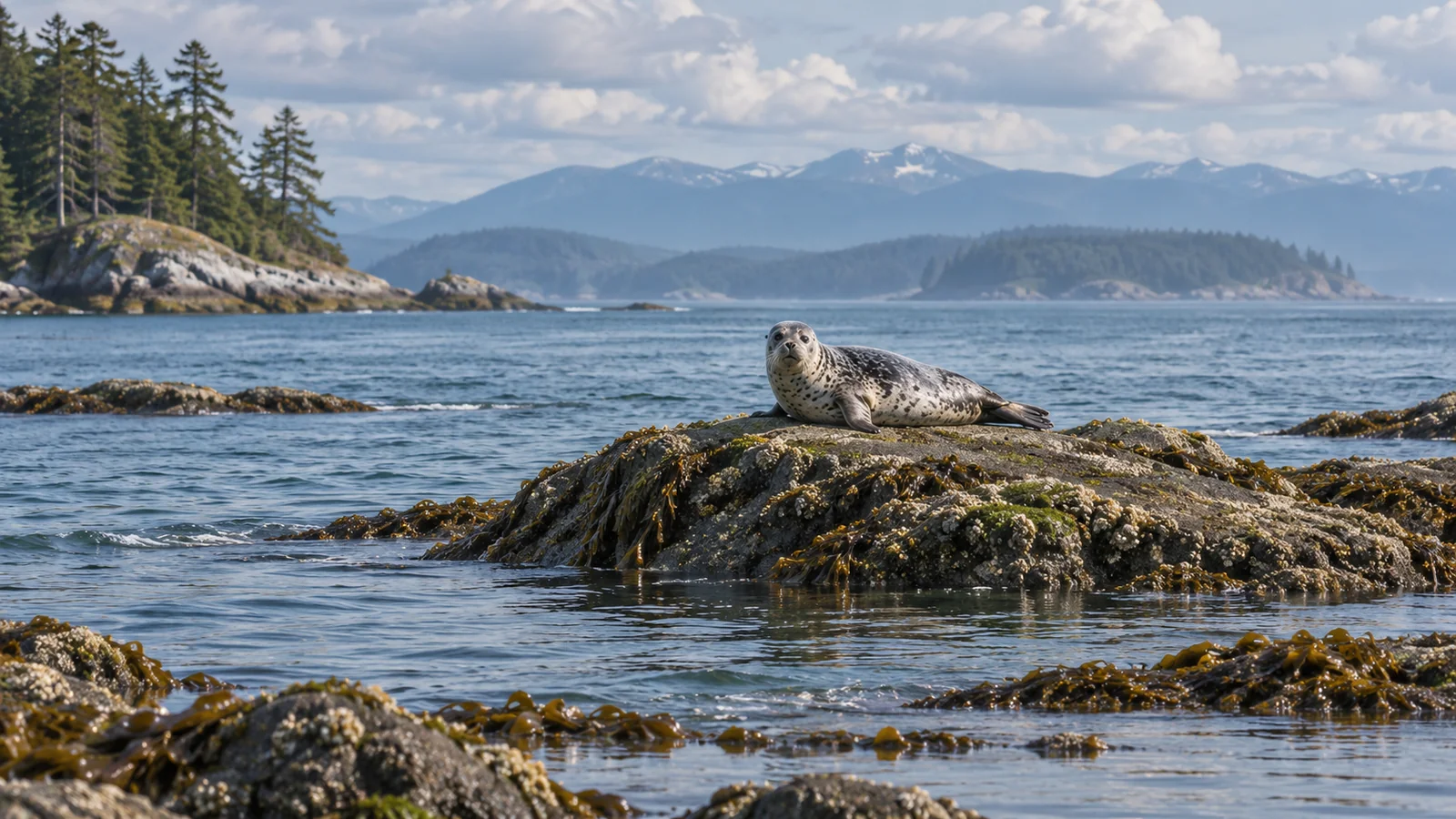
Harbour seals come out of the water, or haul out, to rest and carry out parts of their life cycle such as nursing and moulting. A rock, sandbar or other exposed shore can offer a place to do that close to water. Tides change which surfaces are available, while weather and the time of year can affect when seals use them. Seeing a group on a rock tells you where some seals were at that moment. It does not tell you how many were nearby in the water. Fisheries and Oceans Canada accounts for that distinction when surveying Pacific harbour seals along British Columbia’s coast. DFO harbour seal assessment
What a haul-out gives a harbour seal
The term haul-out describes a place where a marine mammal comes out of the water, or the act of doing so. Harbour seals spend much of their lives at sea, feeding and travelling. They can also rest on shore, give birth there and nurse their young. The site can be open to the air for only part of the day. It can still be useful if the timing lets a seal rest, nurse or use it between trips into the water. DFO harbour seal profile
Picture a seal returning to a low rock after spending time in the water. The rock gives it somewhere to lie without swimming. The water remains close, and the site may sit within a familiar part of its range. Later, when the rock is covered, the seal may be in the water or use another place. Looking only at the patch of rock misses how it fits into a daily sequence of moving between environments.
The term also includes sites used for different purposes. A group resting during one visit may contain animals of different ages and circumstances. At another time, a mother and pup may use the same stretch of coast. A person can describe what the animals are doing if it is visible, while leaving the function of the site open if the observation is brief. The ability to use land is shared among pinnipeds, including both seals and sea lions, although the animals move differently there. NOAA pinniped overview
Why the tide changes what you see
A rock that stays clear at low water may be awash when the tide rises. A broad sandbar may remain exposed longer at one end than the other. The shape and height of the shore determine where those changes are visible. If you return to the same place and the group is gone, first check whether the surface it used is still exposed. A change in the water can explain why the resting site looks different without telling you where each seal went.
In the DFO assessment, surveys were conducted during specific low-water windows when more seals were expected to be hauled out and available to be counted. That method reflects a pattern researchers can use across many observations. It does not say that every harbour seal comes ashore on every low tide. An individual can still be travelling or feeding at the time. One site may also stay available at water levels that cover a different site nearby.
A useful way to watch the shoreline is to notice where water reaches first. One section of a sandbar may become wet while another remains dry. Water moving past a rock can cover the lowest ledges before the top disappears. A group may shift position before you can see an obvious change from shore. If you are writing down what you saw, note the extent of the exposed surface and the time as well as how many animals were visible.
Weather affects the place and the observer
Wind and waves can make a site less sheltered and can make it harder to see animals from a vessel or the opposite shore. The DFO assessment describes survey cancellations in poor weather both because rough conditions can affect hauling out and because visibility affects counting. That creates two separate questions. Were fewer animals on the shore, or did the observer have a harder time detecting them? On a single visit, you may have limited evidence to separate those possibilities.
Imagine looking at the same rock in calm light and then in choppy water under a grey sky. In the first view, you may see the entire outline of each seal. In the second, waves and reflections may obscure the lower edge. If you report a lower count, include what happened to visibility. Researchers need comparable conditions for precisely this reason. A change in the number seen does not necessarily reflect a change in the number present.
Why the season matters
DFO’s harbour seal profile describes pups being born on shore, with timing varying geographically. A mother and pup may use shore as part of a period that also includes movement in water. A pup seen by itself may be resting while its mother is away or waiting nearby. Keep your distance, keep pets away and use the department’s guidance if you think the animal is injured or in distress. Seeing a seal on land is a normal part of observing this species. DFO seal pup guidance
Moulting is another reason haul-out behaviour changes across the year. It involves replacing old hair with new growth. NOAA’s harbour seal profile describes hauling out for activities that include moulting and resting. From a distance, it may be difficult to see what stage an animal is in or why it chose that time to come ashore. The season gives context while leaving the behaviour of individual animals open. NOAA harbour seal profile
Regional timing also matters to scientists. The BC assessment scheduled its surveys around seasonal windows that differ between northern and southern parts of the coast. If a chart compares results from two regions, check the timing and design before assuming each place was surveyed on the same date. The teams aim for comparable conditions relative to the seals’ biology, which can mean visiting different parts of the coast at different times.
Why counting a rock is different from counting a population
A survey team flying above the coast can see animals hauled out on land. It will miss seals at sea that are unavailable to be counted. For the BC assessment, researchers used data from transmitters with sensors that helped indicate when tagged seals were out of the water. They used that information to estimate the share hauled out under the survey conditions. Adjusting the counts lets them estimate a larger population while accounting for the animals absent from the photographs.
Think of two visits with the same number of seals on a rock. One might occur when most of the animals using that area are ashore. The other might occur when many are still at sea. The numbers from the rock are equal. The total number of seals associated with the area could differ. A survey correction addresses the likelihood of seeing seals under defined conditions. It would be misleading to use it as a rule for turning one person’s shoreline count into a local population estimate.
The way the survey covers the coast also matters. Survey flights for the assessment took place across several years to reach different regions under suitable conditions. The resulting estimate combines evidence gathered over time. It is not a simultaneous image of every seal in BC. A visitor can apply the same distinction to reports from different places. A count represents the animals visible at that site at that time. When a report goes beyond that count, check what method it used to support the broader inference.
Why a correction belongs to the survey that produced it
When researchers use information from tagged seals, they need to match it to the kinds of conditions in which their counts were made. A wet or dry reading helps identify whether a tagged animal was available to be seen on land. A reading from another season or time of day might represent a different pattern of use. The assessment describes how the team restricted its comparison to conditions relevant to the survey flights. This helps explain why the adjustment depends on the study design.
You can use this idea when comparing everyday observations. Suppose two visitors photograph a group from different sides of a rocky point. One photo might show animals that were concealed by a ledge in the other. Even if the images were taken at the same time, they offer different views. If they were taken hours apart, the exposed surface and the animals may have changed as well. To make the comparison useful, keep the time and viewing position attached to each count. If the goal is simply to remember which surfaces were in use, a few notes about the tide and weather may tell you more than trying to adjust the number.
How to watch a haul-out from the view you already have
Eagle Eye Adventures’ Campbell River wildlife tour explores the coastal channels and islands with a guide and looks for a range of marine wildlife. If seals are in view, ask which part of the shore they are using and whether it would look different at another stage of the tide. The answer can help you see the relationship between the rocks and the animals. A guide may also help you recognise a harbour seal if a profile or flipper is visible.
Keep the group and shore in view with binoculars from where the guide directs you. Watch for small changes, such as one animal turning, shifting along the rock or entering the water. You may not know what caused a movement. Avoid interpreting every movement as a response to the boat or every period of stillness as proof that the animals were unaffected. Follow the crew’s directions and DFO’s current wildlife viewing guidance. DFO marine wildlife viewing guidance
The guide to marine life on a whale watching tour gives wider context for other animals you may encounter. For this one observation, keep the focus on the conditions you can describe. Note what the animals were doing, which part of the shore was available and how well you could see it. Those details can be more useful than a large count with no record of the view.
Questions about harbour seal haul-outs
Are seals on the shore stranded?
Healthy seals commonly leave the water to rest and carry out other normal activities. Being on land alone does not establish an emergency. If you see an injury or have reason to think an animal is in distress, give it room and consult DFO’s reporting guidance.
Does a group always return to the same rock?
The BC assessment describes strong site fidelity among harbour seals, including returns to familiar areas. That does not imply that each animal uses one rock on every tide. Water levels, activities and the availability of other surfaces can affect which spot is used. The distinction between a familiar area and one exact resting place helps explain why a site can be empty on a return visit.
Is low tide the best time to count seals?
Low-water windows are useful for the specific standardised BC surveys because more seals are expected to be available to count on land. A casual shoreline count still depends on the site, season, weather and animals’ movements. Record the date, local time and the visible area, and interpret your count as an observation of that particular view.