
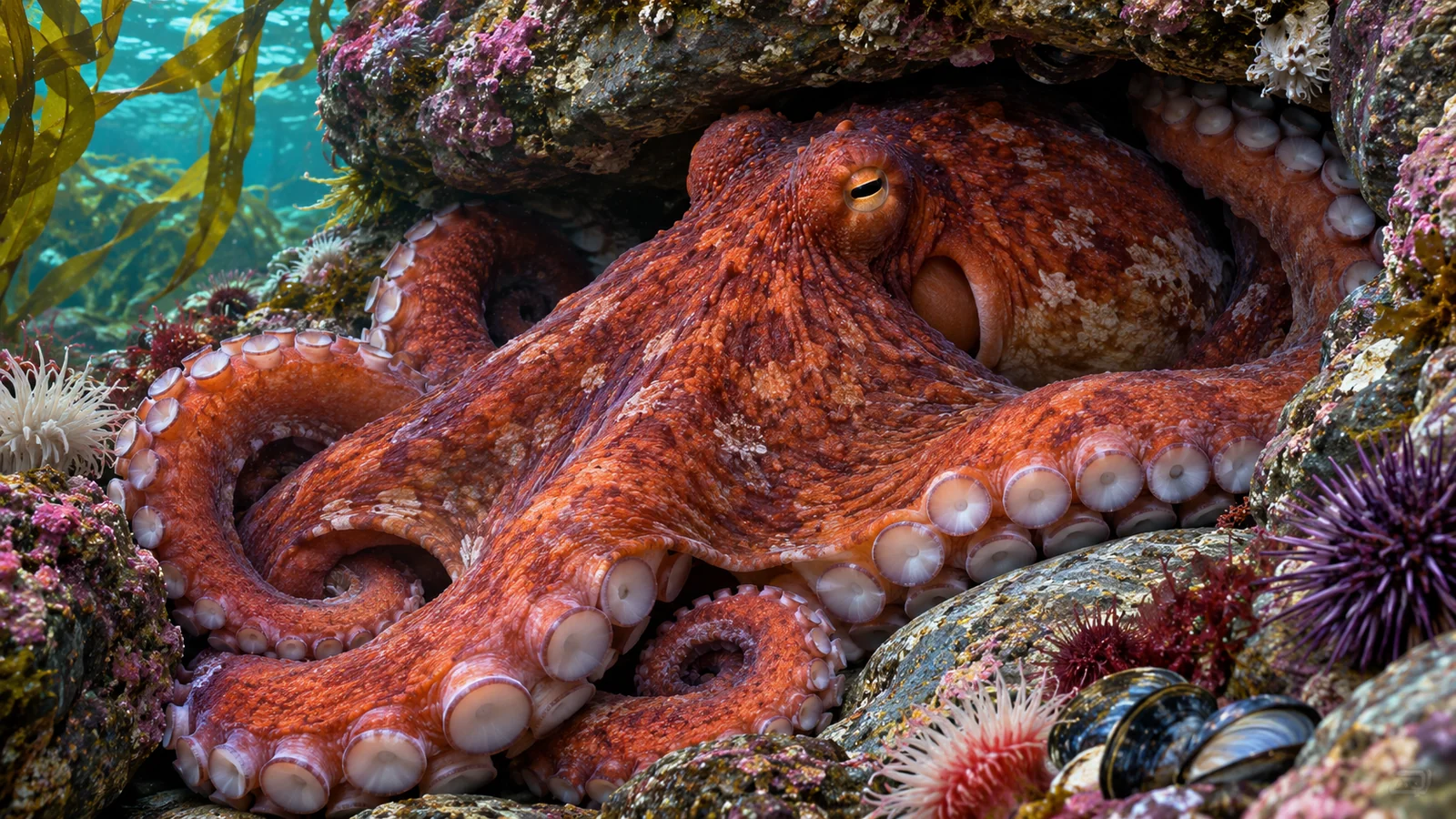
A giant Pacific octopus uses a rocky den for shelter between trips across the seabed. A crevice, hollow or space beneath a boulder can protect a soft-bodied animal and conceal much of it from view. An octopus may return to shelter with prey, leaving shells or crab remains nearby. A female can also attach strands of eggs to the roof of a den and stay there to care for them as they develop. Each use helps explain why the shape and cover of the seabed matter to the animal. Fisheries and Oceans Canada coastal species account Alaska Department of Fish and Game giant Pacific octopus profile Monterey Bay Aquarium giant Pacific octopus account
A den can be hard to read from the outside. A slit in the rock may open into a larger cavity, and most of the animal can remain inside. A pile of shells can suggest past activity but has several possible explanations. You can understand a good deal about how the habitat works by looking at the shelter and surrounding seabed, even when the animal itself stays hidden.
Why a narrow opening can work
A giant Pacific octopus has a flexible body and no rigid external shell. It can fit through openings that look small relative to the size of its arms when extended. The hard beak sets a limit to the spaces it can pass through. When the rest of the body is folded close, a space within the rock can accommodate an animal much larger than an observer might first expect from the opening. Monterey Bay Aquarium giant Pacific octopus exhibit NOAA technical account of the giant Pacific octopus
A useful den has to provide more than a gap visible from above. Its interior must have enough space, and the opening offers a way in and out. An overhanging rock can conceal an animal from a passing predator and separate it from open water. In some cases an animal can use a space in a rocky reef or excavate part of the sediment below cover. DFO’s BC species account describes dens in rocky areas and use of sand-shell substrates by some smaller animals.
Camouflage adds another layer of cover. The animal can change colour, which can make an exposed part of an arm or mantle difficult to separate from nearby rock. If you’re watching video of an octopus, pause before it moves and see which parts of its outline were visible. An eye or the edge of an arm can stand out once you know where to look. A person looking at a reef in real time may have little chance of detecting the same detail.
A den can be a starting point for foraging
Giant Pacific octopuses take prey such as crabs, clams and fish. They can leave cover to search the surrounding seabed, and they sometimes bring food back to a den to eat. A rocky landscape can offer both shelter and places where prey live. The space an animal uses for cover and the larger area it visits for food are therefore parts of the same habitat. Study of giant Pacific octopus foraging
Picture an octopus leaving a cavity to search a nearby patch of rock and sediment. It can use its arms and suckers to explore surfaces and seize prey. If it brings a crab or clam back, the place where you find the remains may be the place where the octopus fed, even though the prey came from somewhere else. A den can therefore provide a local record of activity that occurred across a broader area.
Researchers have used several ways to investigate that activity. Field studies have examined prey remains near dens, followed movements and tested how octopuses use experimental food patches. Each method captures a different part of the sequence. A tracking record can show where an animal spent time without identifying everything it ate. A prey sample may identify what was left behind without showing the route to the prey.
What a shell pile can tell you
A collection of discarded material beside a den is called a midden. It may contain clam shells, crab parts and other hard remains after an octopus has eaten. The material can be useful because some pieces preserve enough shape to identify prey. Biologists have studied giant Pacific octopus diets by examining den litter and comparing it with information on the living prey nearby. The two records can help show which animals were available and which ended up in the collected remains. Vincent and colleagues, field study of giant Pacific octopus diet and foraging
A midden has limits as evidence. A clam shell can persist longer than soft prey. A current can move pieces or bring in material from elsewhere. Scavengers can remove part of the pile. A crevice with shells outside it may have been used by an octopus earlier, and a pile could also have accumulated by other means. If you see shells beside a crack in the reef, you can describe their position and type without deciding from the pile alone whether a den is occupied.
A useful comparison is to imagine two prey items, a clam with a substantial shell and a soft-bodied animal. The first can leave a visible record after the edible part is gone. The second may leave little an observer can recognise. If several clam shells accumulate and none of the soft prey can be identified, the pile will make clams look more prominent than they were in the full diet. A study that reports how remains were collected and what else was measured helps you interpret that difference. Study of giant Pacific octopus diet specialisation
How the den protects developing eggs
A female giant Pacific octopus can attach strings of eggs to a den’s ceiling. She stays with them as they develop, tending them and moving water over them. The cavity provides a surface for attachment and cover around the developing eggs. The brooding period lasts for months in some conditions. A den used for brooding serves a different purpose from a shelter an animal leaves to forage and returns to between trips. Monterey Bay Aquarium giant Pacific octopus exhibit
From outside a cavity, you may be unable to tell how it is being used. Eggs can hang farther back or overhead. The fact that the opening looks empty tells you only what you could see at that angle. Leave the opening clear and the surrounding rock in place. An observation is still worthwhile when it records a feature of the habitat without confirming what is inside.
The hatchlings enter a different stage of life from the adult on the reef. Early stages spend time in the plankton before animals settle to use bottom habitat. A place that shelters eggs is therefore connected to the water moving past it, and the conditions needed later can be elsewhere. When you read a description of octopus habitat, check which stage it covers. A rocky den is central to parts of the adult’s life while the young can spend their early lives in open water.
What a reef survey can see
An octopus can be harder to detect than a fish swimming above the reef. On a brief survey, the body may be inside a cavity or blend into the rock. A second pass under different conditions can provide another view, but a count still depends on how the search was conducted. NOAA Fisheries describes research in Alaska that uses artificial shelters to sample octopuses. The design makes use of their interest in cover and illustrates why different survey methods can find different parts of the population. NOAA Fisheries octopus research in Alaska
Consider two underwater surveys. One follows an open strip of sandy bottom and records exposed animals. Another passes through broken rock with many spaces that could hold a den. If the rock survey records fewer octopuses, there could be fewer animals there or more of them could be concealed. Without a way to account for the difference in visibility, it’s difficult to choose between those explanations. A record of the type of bottom and the part of each animal that was visible can help make a comparison more useful.
How a den can shape the route an octopus takes
Field tracking in Alaska documented both movements that looped back towards a den and movements associated with relocation. The researchers described how octopuses used crevices and spaces under boulders. The tracked paths show why a den matters beyond the minutes an animal spends inside it. A shelter can be an endpoint to return to after searching a patch of seabed. An animal that moves to a different refuge may start using another part of the reef. Scheel and Bisson, giant Pacific octopus movement study
A straight line drawn between two locations can miss details of what happened in between. The octopus may follow a ledge, pause under cover or turn along a change in depth. A series of tracking positions can show the general route and reveal repeated returns. It will still have gaps that depend on how often the instrument could detect the animal and how precisely it could place it. The route gives evidence of movement. An observation of prey handling or a food sample is needed to learn more about feeding during the trip.
You can think about the surrounding reef in the same way when watching footage. Notice where the rock offers repeated openings and where the seabed becomes open. An animal moving along the wall can pass in and out of view without ever travelling far from the camera’s field. If it disappears behind a boulder and reappears, describe the route you actually saw. A longer recording may establish whether it returned to the same refuge. A momentary disappearance can simply mean it passed behind part of the reef.
Observe the habitat while leaving the den alone
A giant Pacific octopus lives beneath the surface in British Columbia. A boat outing or shoreline walk can help you recognise the wider setting of rocky points, submerged ledges and changing water depth, even though the animal may remain out of sight. Eagle Eye Adventures’ guide to marine wildlife around Campbell River introduces animals more likely to be apparent at the surface and gives context for the coastal habitats around them.
If you see an octopus while diving with appropriate training or by watching underwater footage, look at how much of its outline is visible and where the rock begins to conceal it. A view from outside the den is enough to describe the opening and any exposed part of the animal. Leave shells and stones where they are, and avoid trying to coax the animal into view. In an image, a wider frame can show the relationship between the animal and the cavity. A tight crop may reveal a row of suckers while hiding the structure that gives the animal cover.
A good observation might read “part of one arm at the mouth of a rocky cavity, several shell pieces nearby.” That preserves which evidence came from the animal and which came from the site. If the animal withdraws, let the observation end there. Its ability to disappear into the reef is part of what the rocky den provides. Note whether you saw the animal turn, draw in an arm or simply vanish behind the edge.