
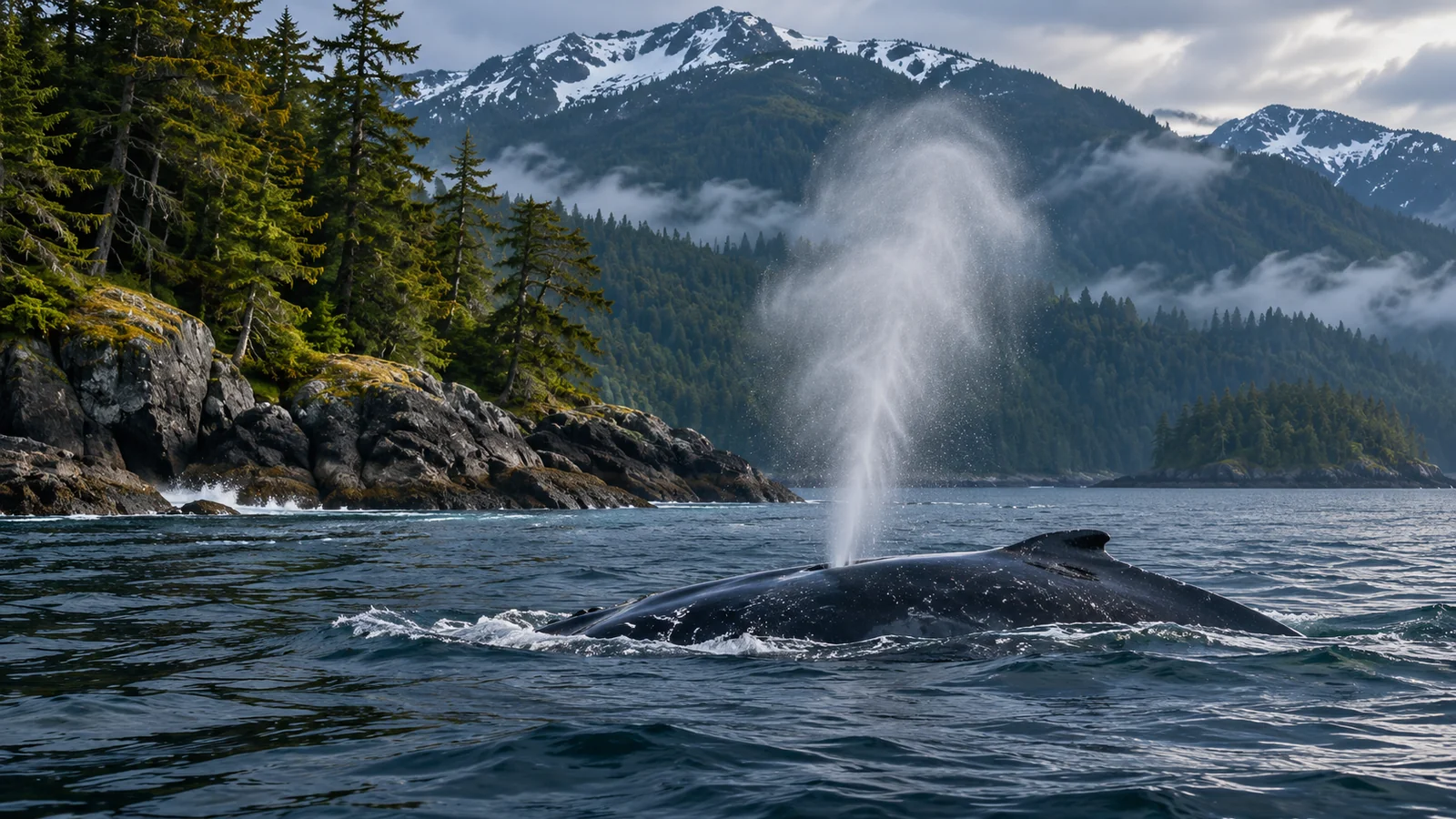
A whale blow seen from shore tells you where an animal has just surfaced to breathe. Its height, width and direction may help you narrow the possibilities. A humpback often produces a bushy plume, while a sperm whale’s blow can angle forward. Wind and viewing angle can change how either looks, and the species may remain unclear until you see the head, back or tail. On a shoreline watch near Campbell River, use the first blow to mark a patch of water. The next surfacing often gives you more information than trying to name the whale from the shape of one plume.
What you are seeing when a whale blows
A blow forms when a whale exhales at the surface and moisture becomes visible in the air. It can contain condensed droplets and water displaced near the blowhole. How bright or tall it looks depends in part on conditions around the whale. Light behind the plume can make it stand out. Glare on the water can hide the point where the whale surfaced. From shore you may see the plume without seeing the breath or the animal’s outline clearly. NOAA Stellwagen Bank guide to whale behaviour
A plume also changes as soon as it appears. The part closest to the whale may rise in one direction, while the upper part begins to move with the wind. A picture taken at the start can look different from one taken an instant later. If a guide describes the blow as slanting, ask whether they saw that direction at its origin or after the mist had spread.
Splash and spray can look similar at a distance. White water from a wave usually relates to the position of the crest. An animal’s blow may appear as a brief upright or angled plume followed by a dark shape. The sequence can help when the distinction is unclear. Look for a second surfacing nearby and for a repeat of the same pattern. If you saw only a flash of white, keep the observation open.
Start with the position, then look for shape
Choose a fixed point that helps you relocate the patch, such as the edge of a headland or the line below a distinctive tree. If the animal is offshore from a moving vessel, the vessel may be a poor reference. Keep track of the direction the whale seemed to be travelling. A blow can disappear before someone else has time to look, so a landmark is often the most useful thing to tell a companion.
When you see another plume, notice its overall shape at the start. Does it spread into a broad cloud, rise in a narrower column or angle forward near the animal’s head? Compare what you see across several breaths. A plume can appear tall when it stands against a dark shoreline and short when only its top is visible over waves. The angle between you and the animal also changes how much of the shape you can see. DFO illustrations of blowing and diving characteristics
A pair of binoculars helps once you know where to look. Begin with a broad view to spot movement, then raise the binoculars while keeping your eyes on the same patch. If you start with high magnification and scan too far away from the first blow, it is easy to miss the surrounding surface. A wide search also helps when more than one whale is present.
How common blow shapes can help
A humpback blow often appears broad and bushy. After it, you may see an arched back and a relatively small dorsal fin. If the whale lifts its flukes before a dive, their shape and markings may add another clue. The outline of the plume can look narrower or more diffuse in different conditions, so combine it with the back and the surfacing sequence.
A grey whale blow can look bushy or heart-shaped in favourable conditions. The body profile can be more useful when the plumes overlap in appearance. A grey whale lacks a true dorsal fin and has low bumps along the rear part of the back. A humpback has a dorsal fin and may show a different arch as it prepares to dive. If the water is rough and most of the back is hidden, neither clue may be available on the first surfacing. Greater Farallones whale identification guide
A fin whale can produce a tall, relatively narrow blow. Its long back and the timing of the dorsal fin’s appearance can provide context if you can see them. An angled sperm whale blow can be distinctive, especially with a view of the head and the beginning of the plume. The species in a regional identification guide are possible in the broader Northeast Pacific. They are not equally likely from every viewpoint in British Columbia. DFO guide to cetaceans of British Columbia
Let wind, distance and angle explain what changes
Imagine a humpback surfacing in a strong crosswind. The plume starts near the blowhole and then bends toward one side. From shore, the visible part might seem to emerge at an angle. If the animal turns, you may see the next blow from a different perspective even if the wind has stayed the same. The direction relative to the whale’s head, when you can see it, matters more than the direction the mist ultimately drifts. NOAA whale identification field guide
Distance changes how much detail reaches you. A tall plume farther out can appear smaller than a lower plume closer to shore. Without a reference at the same distance, a height estimate can be misleading. At greater distances you may also miss the lower parts of the plume behind waves. For a shore note, use a description such as “broad and diffuse at this distance” rather than assigning a precise height.
Background and light can change the view within a few seconds. Mist may be easy to see against a dark bank and almost vanish against bright sky. A change in the whale’s position can therefore make its blows appear to change size. If you are trying to compare them, note the direction of the wind and where the plume appeared relative to the backdrop. These details also help when another person is watching from a different angle.
Read what happens after the blow
The first thing visible may be the plume above the water. The head or back may appear a moment later, and the dorsal fin might be visible on only some surfacings. Watch how those features follow one another. If a whale travels through the patch, notice whether you can follow a long stretch of back or only a small arc. The sequence gives you more than a snapshot of the plume.
Look for a pattern across breaths. A whale may surface several times before disappearing for a longer period. If you are watching several whales, the blows can overlap. More plumes do not necessarily mean more individuals. A minimum count is stronger when you can see separate backs at the same time or consistently track different animals in different positions. When those details are missing, describe the number of blows without converting them into an animal count.
A tail lift can provide useful evidence, especially if it shows the shape and underside of the flukes. Some whales will dive without exposing the tail from your angle. You can still combine the plume, head and back if they were visible. If the animal disappears after the first blow, leave the identification at the level you can support.
Work through a shoreline example
Suppose you notice a wide plume against the far shore. You point out a landmark and see a second blow slightly to one side. On the next surfacing, a dark back arches and a small dorsal fin appears. The combination gives you more reason to consider a humpback than the width of the first plume did. If the back showed only a partial curve and you never saw the fin, a more cautious description might be that you saw a large whale with a bushy blow.
Now imagine a plume seems to angle sharply in a strong wind. You can see its top clearly but lose the point of origin in glare. Before using the angle to suggest sperm whale, look for whether the blow began that way and whether the animal’s head fits that interpretation. If you saw only windblown mist and no head, the observation remains useful as a possible whale sighting. It has too little detail for a species conclusion.
Use the same method off Campbell River
Pick a public place with an open view and keep your focus on a section of water you can scan without moving near an unsafe edge. Compare the surface with a fixed landmark. A passing vessel can stir water or momentarily block the view, and a whale may remain submerged through a long part of the watch. Give yourself time to see whether the pattern repeats. Record the location, time, viewing conditions and which parts of the animal you saw. Eagle Eye’s guide to marine wildlife on whale watching tours
On a guided outing, tell the crew which direction you saw the plume and when it appeared. A guide may already be watching that area and can explain what other clues fit the identification. The vessel can provide a different viewpoint from shore while remaining subject to viewing rules and changing conditions. If you are comparing trip options, check the available departures and choose an outing that fits the time you want to spend on the water. DFO marine wildlife viewing guidance · Eagle Eye’s Campbell River whale watching tour
If you share a photo later, retain the frame that shows where the plume begins as well as any view of the back. The full scene can preserve the distance between the animal and a landmark or the direction of the windblown mist. A tightly cropped cloud may make the shape easier to see while obscuring the clues that help someone interpret it. Include what you could see with your own eyes if that differs from the photo.
Frequently asked questions
Can a whale be identified from its blow alone?
Some plumes are distinctive under favourable conditions. Wind, distance and angle can make them look alike. Look for a second surfacing and compare the visible head, dorsal fin, back or tail with the plume before assigning a species.
What does a humpback blow look like?
It often appears as a broad or bushy plume. The apparent width and height change with conditions. A following view of the arched back, dorsal fin or raised tail can add information.
Can I estimate how many whales are present by counting blows?
One animal can breathe several times. If you can see separate backs together, you can report a minimum number of individuals. If you saw only plumes at different times, record those as breaths or surfacings unless you could follow separate animals.
How should I describe a sighting when I only saw mist?
Record the time, direction, location and viewing conditions. Say whether a dark back, movement or a repeated plume made you think it was a whale. A brief observation can be useful without a species identification.
If you return to the same viewpoint, note the state of the water even on days when you do not see a blow. A calm day with dark water behind the plume offers different viewing conditions from a day of whitecaps and reflected light. Keeping those details beside your sightings can explain why the same part of the channel was easier to watch on one visit than another.