
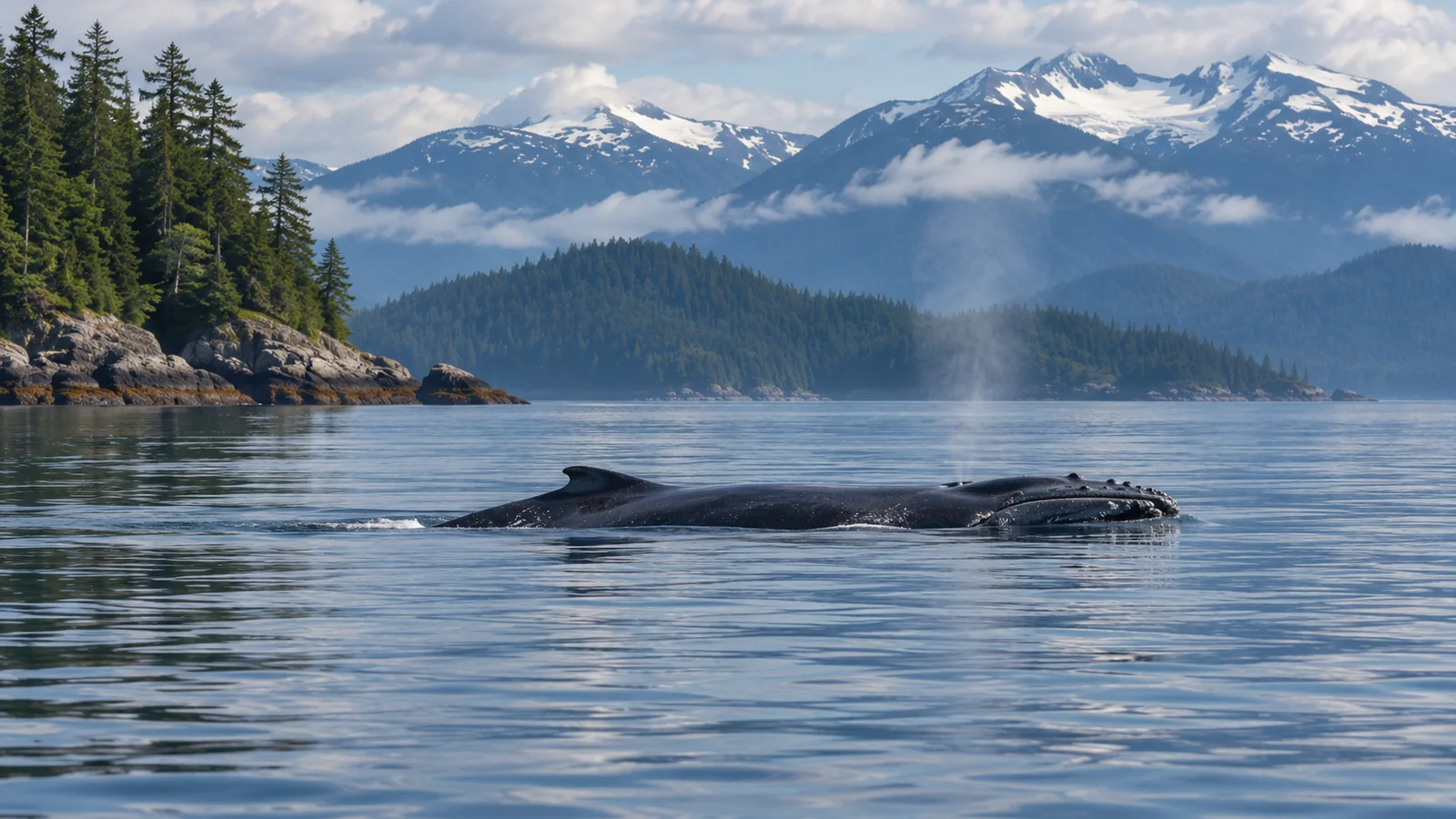
A humpback resting at the surface can look like a dark log with a small part of its back exposed. It may drift, make few visible movements and surface to breathe without the steady progress you would see from a travelling whale. This behaviour is often called logging. A short view gives you only a clue, because an animal may pause between other activities or rest below the surface. In Canada, Fisheries and Oceans Canada directs boaters to keep at least 200 metres from a whale, dolphin or porpoise that is resting or with a calf. On a Campbell River tour, let the crew manage the vessel’s position while you watch. DFO marine wildlife viewing guidance
What logging looks like from a distance
Logging describes the appearance of a whale lying near the surface for a period with relatively little movement. From a boat or shore, you may see a long section of the back with only part of the head or dorsal fin visible. The outline can be hard to distinguish from floating debris, especially when the water is broken by waves. A blow or a change in the body’s position can draw attention to the animal. A brief view of the back often gives too little evidence to classify what the whale is doing. Study of humpback resting behaviour using an underwater video logger
Watch for a pattern over time. If the same animal remains in a broad area with little visible movement, that fits a common description of surface rest. A whale travelling near the surface may also be quiet, but repeated surfacings can show steady progress in one direction. Other behaviours, such as a pause between dives, may begin similarly. Give yourself time to see a sequence from the position you already have.
The whale may move even when there is no obvious stroke. Wind and current can shift its position relative to the shore or the vessel. A boat can drift as well. If you want to describe the movement, compare it with a fixed landmark when one is available. It can help you tell whether the scene is changing because of movement by the whale, the boat or both. Where there is no fixed reference, describe how the whale looked rather than trying to estimate its speed.
Resting and sleeping describe different evidence
A person watching a humpback from a distance can observe posture, movement and breathing. These clues may support an interpretation of rest. The observer cannot see a whale’s neurological state from the deck of a boat. In research and trip notes, “resting near the surface” or “appeared to be logging” describes what the behaviour looked like. The word sleeping can be used in a general explanation, but a particular sighting seldom establishes the precise state of the animal.
A distinction also matters between being still and resting. A photograph freezes one instant. A whale could be travelling slowly, turning, preparing to dive or already resting. Researchers who describe a state often look at a period of behaviour and use measures such as swimming speed, orientation and the pattern of flipper or tail movements. A sustained pattern gives them more evidence than the absence of movement in a single frame.
A surfacing to breathe does not necessarily end a resting period. Whales breathe air and may need to reach the surface even while conserving energy. From a distance you might see a small change in position, a blow and a return to a quiet posture. Recording the order is a useful way to describe the encounter. If the whale then changes direction and begins to travel, you can distinguish the two periods in your notes without knowing exactly when its internal state changed.
Rest can happen below the surface too
A study using an animal-borne video logger and movement data described a humpback making slow drift dives with few low-amplitude strokes. The video also showed other nearby whales during the period the researchers interpreted as rest. This work added an underwater view to reports of surface logging. Its evidence concerned a particular tagged whale and its companions, so it leaves open how often other animals use the same pattern.
A boat observer has a limited view of this part of the water column. If a whale submerges and does not appear for a while, its absence from the surface does not show whether it was travelling, feeding or resting below. A research tag can record depth and motion through the period when people at the surface cannot see the animal. It has its own limits, including the length of the deployment and the number of animals observed.
In work on humpback mothers and calves in Hawaiian breeding waters, researchers combined tag records and aerial measurements to investigate the energetic benefits of rest. The study’s methods note that distinguishing surface rest from wave movement in accelerometer records can be difficult. That is an example of why researchers state how they classified behaviour. A method that works well for describing one kind of rest can leave uncertainty about another. Study of energy use and rest in humpback mothers and calves
Why the pattern might change with context
A whale’s day includes breathing, travelling and other activities. Rest can occur between periods of movement and may look different when the animal is alone, near companions or with a calf. Research on mother and calf pairs answers questions about animals with particular demands in a breeding area. A boat sighting of an adult humpback in a British Columbia feeding area has a different setting. The study can help you understand possible ways whales conserve energy without establishing how the individual you see divides its time.
Even two observations of the same whale can be difficult to compare. An animal may be barely visible on a windy day and easy to follow on a calm one. If it rests just below the surface, you may see fewer signs than you would if it were logging with part of its back exposed. An observer’s description reflects the conditions as well as the whale’s behaviour. Keep both in the record if you want to compare encounters.
In a multi-whale encounter, one animal’s movement can be easier to follow than another’s. A calf or smaller whale can be obscured by the body of a larger one. If a guide asks you to watch a broad area, the wider view can help you see that the scene contains more than one surfacing pattern. The crew may also need to account for animals that are present but difficult to see from the deck.
Why Canadian boats give resting whales more space
Fisheries and Oceans Canada directs boaters to keep at least 200 metres away from whales, dolphins and porpoises that are resting or with a calf. Its guidance also describes species and area-specific rules, including for killer whales. Check the applicable information for where you are boating. If you see a low, nearly motionless humpback, allow it space rather than moving in to find out how still it is. The viewing decision can be conservative even while the interpretation remains uncertain.
A whale that shows little of its body is also easier to miss in a channel with wind, glare or vessel traffic. Watch well ahead and keep the animal in view if you can do so safely from a suitable position. If you are aboard a tour, point out where you saw the back or blow and follow the crew’s instructions. The crew manages vessel position, the surroundings and the applicable approach distance. You may have a useful view even when the boat gives the animal a wide berth.
A still whale can begin moving or disappear beneath the surface. Give it room for that change. A camera with a longer lens or binoculars can help from an existing viewing position. A single wide photograph can also preserve where the whale was in relation to landmarks. A new angle may improve a photograph, but it is secondary to allowing the animal to continue what it was doing.
What to record on a Campbell River trip
If you see a humpback at the surface, note how long you observed it and whether it appeared to make progress. You might record that the same stretch of back remained visible between several breaths and that the whale later dived. If the animal disappeared behind a swell or the boat moved, say when you lost sight of it. That information helps someone understand the limits of the record.
Ask the guide how they distinguished rest from slow travel. They may have watched the animal before you noticed it. They may also know whether it was accompanied by another whale or a calf. An answer based on several minutes of observation can put your short view into context. If they call the behaviour uncertain, you can still learn which details they were looking for. Eagle Eye’s guide to marine wildlife on whale watching tours
Choose a whale watching trip around its departure information and the kind of time you want on the water. Rest is one of several behaviours you might hear discussed if a humpback is encountered. A quiet animal can give you a chance to watch breathing and posture. A change in course or a shorter view can also be part of responsible observation. Eagle Eye’s Campbell River whale watching tour
How to interpret a short video of a resting whale
Check how long the original video ran and whether it shows the same animal throughout. A few seconds can show posture. A longer view may show whether the animal stayed in one area or moved steadily through it. The camera may pan or zoom, so apparent movement within the frame does not always correspond to travel. Landmarks, a wider frame or the observer’s notes can make the difference clearer.
If you share the clip, describe the visible sequence and the context. “The whale stayed at the surface with little visible movement for several breaths” is a more precise description than an assertion about sleep. If you were told the whale was resting, include the source of that interpretation and any observation that supported it. A person reviewing the video later can then see how you reached the description.
Frequently asked questions
Does a floating humpback always mean it is asleep?
A whale with little visible movement may be resting. A distant observer can describe its posture, breathing and movement, but may have no evidence of its exact sleep state. Watch the sequence from a safe position.
Can humpbacks rest underwater?
Researchers have described slow drift dives interpreted as rest in a study that combined underwater video with movement records. It is evidence that rest can take forms a surface observer cannot see clearly.
How much space should boats give a resting whale in Canada?
Fisheries and Oceans Canada says to stay at least 200 metres away from a resting whale, dolphin or porpoise or one accompanied by a calf. Check the agency’s current guidance for any additional requirements in your area.
Does a quiet whale need help?
Quiet behaviour by itself can fit normal rest. Visible gear, an injury or another sign of distress calls for a different assessment. If you are on a tour, alert the crew to what you saw. Follow Fisheries and Oceans Canada’s reporting guidance for a suspected marine mammal incident. DFO Observe, Record and Report
When the only visible cue is stillness, note the duration and the conditions. Those details help distinguish an ordinary quiet interval from an observation that also includes a reason for concern.