
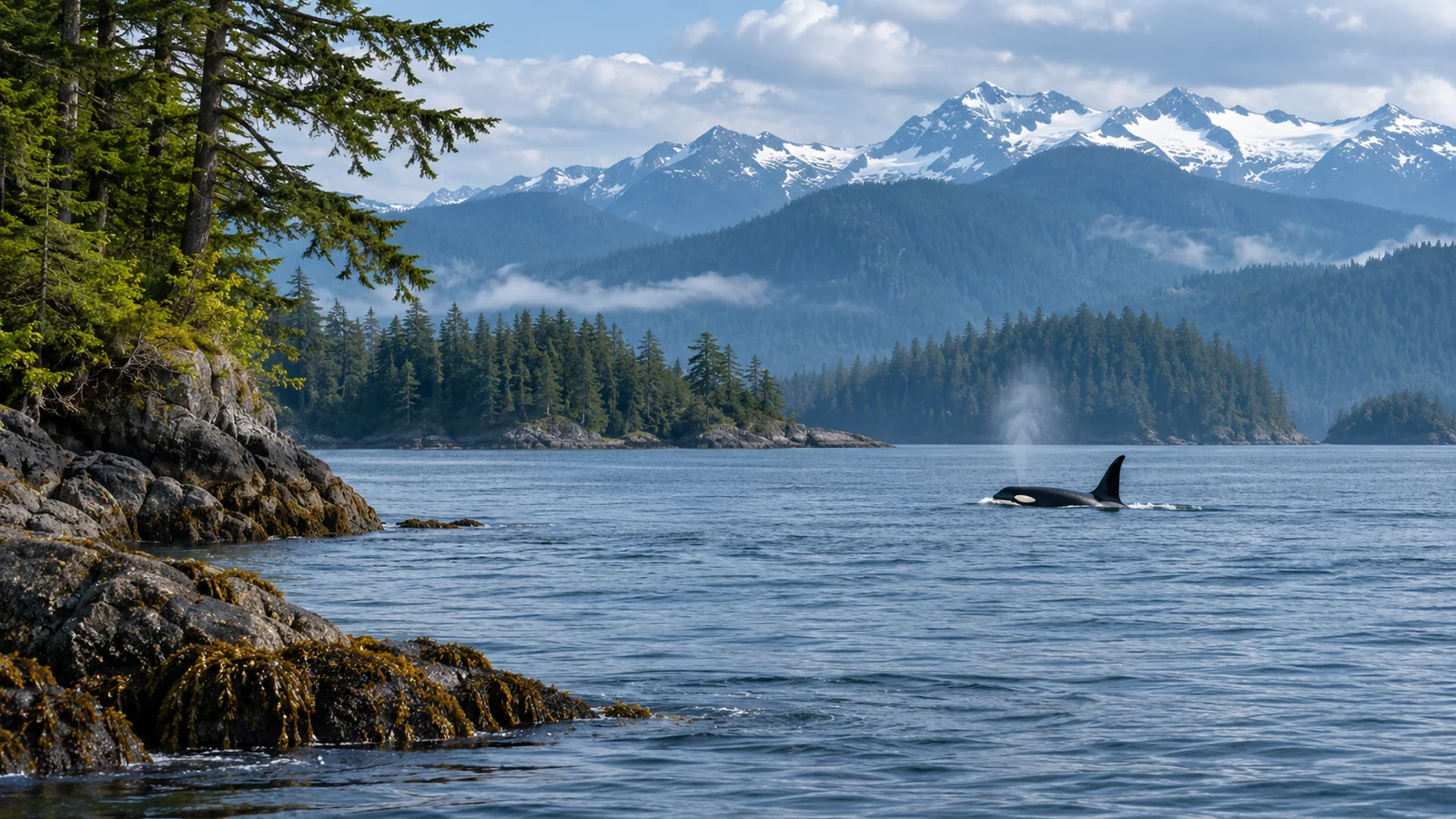
Springer and A73 are two ways of referring to the same Northern Resident killer whale. A reader may first meet her through the story of her rescue and return to coastal British Columbia. A researcher looking through records might start with her catalogue ID. The two labels can lead to the same animal, but their usefulness depends on the context. An identifier helps connect sightings, photographs and family records over time. A familiar name can make a story easier to follow. If you hear either kind of label on a Campbell River whale watching trip, ask which catalogue the guide is referring to and how the animal was identified.
Start with the individual
A killer whale catalogue is an organised record of animals that researchers can distinguish. It usually relies on photographs that preserve recognisable features. In the eastern North Pacific, the shape of the dorsal fin, marks along its edge and the shape and appearance of the saddle patch can help distinguish one killer whale from another. The saddle patch is the lighter area behind the dorsal fin. The combination of visible features matters, particularly if one trait is common or hard to judge from a single angle. Canadian resident killer whale recovery strategy
Once researchers can distinguish an animal reliably, an individual identifier provides a durable reference. The label lets them compare records without having to describe the dorsal fin every time. Think of it as a way to find the correct set of photos, dates and observations. The evidence behind the label remains important. If two animals have similar profiles, a new photograph may require review before researchers attach it to either record.
A catalogue can show more than a series of fin photographs. Depending on its scope, an entry may include known relatives, first and later sightings, or other information that the research team can support. Some fields may be unknown. A catalogue entry should be read with its notes and methods, especially when you want to know whether a relationship was observed directly or inferred from repeated associations.
What the letters and numbers can tell you
The letters and numbers make sense within the catalogue or programme that uses them. For example, the Center for Whale Research presents Southern Resident records under J, K and L pods. J35 is an individual in J pod. The centre’s record for J57 identifies J35, Tahlequah, as the calf’s mother. Reading the two identifiers together gives a useful family example. The digits in J57 do not give the animal’s age or directly state the mother’s identity. You find that relationship by reading the underlying entry. Center for Whale Research’s J57 record
Northern Resident records use their own context. NOAA Fisheries identifies Springer as A73 and describes her membership in A4 pod. Knowing both references helps you follow a record of an individual and a description of the group she belongs to. An encounter report might mention the pod, a smaller family group or particular whales. It is possible to establish which pod was seen without being able to identify every individual from the available photographs. NOAA’s Springer educational materials · DFO Northern Resident photo-identification catalogue
The West Coast Transient population of Bigg’s killer whales has a separate body of identification records. Its catalogue context is important when a guide refers to a T identifier. Fisheries and Oceans Canada’s catalogue for the coastal subset draws on identification records collected across decades. If you encounter an identifier from that programme, read the individual entry and its explanation before assuming that every letter or number has the same role as it does in a resident catalogue. DFO coastal Bigg’s killer whale catalogue
How a familiar name and a catalogue ID work together
A name can help a general audience keep track of an animal across several stories. NOAA’s description of the 2002 rescue pairs A73 with Springer, giving readers a link between public reporting and research records. Later NOAA reporting identifies her and her calf Storm, A116, in a photographed encounter off British Columbia. A reader can search for A73 alongside Springer to find agency accounts that use either form. NOAA’s account of the Springer rescue · NOAA’s follow-up on Springer and her calves
A familiar name may appear in outreach articles and trip accounts, while a scientific paper may use an identifier throughout. When both are established in a reliable source, write them together on first mention so the reader can find the same animal in both contexts. Use the form the source gives. If you find a name in a visitor’s account with no ID or original reference, you may need more information before connecting it to a research entry.
This use of the word name is different from the common species names orca and killer whale. Both of those names can refer to the species, while Springer refers to one animal. If someone asks how the species came to be called the killer whale, they are asking a question about language and history. A research ID has a more specific job. It refers to the same animal each time it is used within its catalogue. Eagle Eye’s guide to the name killer whale
How an identification gets checked
Imagine a photographer brings back a clear image of an orca’s left side. A reviewer can examine the silhouette of the fin, look for nicks and consider the visible edge of the saddle patch. A known reference image from a similar side and angle gives them a starting point. If several features agree, they may have a credible candidate. If only one feature is visible, they may ask for more photos or keep the identification provisional.
The context of the encounter can provide another clue. Nearby whales may also have been photographed, and some may match known relatives or associates of the candidate. Those associations can help reviewers know which catalogue entries to examine. They still need evidence for the individual in the photograph. A family can be spread out or accompanied by other whales. A familiar pair of companions should not automatically determine the identity of an unclear fin.
Researchers also have to work with photographs from different years. A whale can gain a scar or a new nick. Its profile can change as it matures. The angle of the camera and the position of a surfacing animal can affect the outline in a single frame. A sequence of images and older records give reviewers more opportunities to recognise the same combination of features. A good match accounts for both persistent characteristics and changes documented over time.
Why the same ID matters across encounters
With a stable individual record, researchers can compare places and dates. If a matching whale was photographed in two areas, the catalogue helps establish that both records refer to the same animal. Scientists can use those records to investigate movements and associations. The two photographs alone cannot show the precise route between them. The ID links points in the record so researchers can investigate the questions those points raise.
A long-running catalogue can also help with population studies. A series of confirmed identifications provides evidence about which animals were seen and in which periods. Repeated encounters can add information about family associations or calves. One trip seldom gives researchers a view of every animal in a group, and coverage varies. The catalogue’s scope and the survey methods matter if you are using the records to understand population size or changes. Canadian killer whale status assessment
A newly documented ID is also different from a known birth. A clearly identified calf photographed with a known mother can support a birth record. The first clear photo of an older whale simply establishes that the research team could document that individual by that time. Look for dates labelled first sighting, estimated birth or confirmed encounter. Those labels describe different pieces of evidence even when they appear on one page.
What to do when you hear an ID on the boat
Ask whether the guide identified the animal from the current encounter, matched it after viewing a photograph or is describing a different sighting. If the group is far away or only a few fins are visible, species may be the most specific identification available. Good guides can explain what they could see and which details would make a more precise match possible. You can take notes without expecting the crew to change course for a closer look. Eagle Eye’s Campbell River orca guide
If you keep a wildlife journal, record the ID exactly as you heard it and note the source of the identification. If someone mentioned a possibility, write it as a possibility. You can look up the relevant catalogue after the trip and see how the example fits within the family or population. For a photo of your own, preserve the date and general location. Those details are more useful than a confident guess based on a single feature. Eagle Eye’s Campbell River whale watching tour
How to compare two catalogue entries
Check the publication date and which animals the catalogue covers. An older report may give an excellent photographic reference for a whale, even if a later edition contains more recent observations. Two reports can also cover different parts of the same population’s range. An entry that appears in one and is absent from another may reflect a difference in scope. Compare the notes before drawing a conclusion about an animal’s status or the way it was identified.
Consider two records labelled with the same familiar name but different identifiers. Find the original catalogue for each and compare the population, source date and photographs. A secondary account may have a typographical error. A familiar name may also be used informally in more than one setting. Quoting the source and the complete identifier makes it easier for a reader to see whether the two accounts refer to the same animal.
Use the same care when interpreting a group label. A table may use one individual’s ID as a reference in the heading of a family group and list several related whales below it. In an encounter narrative, the same ID might refer to a sighting of that one whale. The column heading or caption tells you which meaning applies. Retain that information when you take notes or copy an entry for later reading.
Frequently asked questions
Does every killer whale have a public name?
Public-facing names are used for some individuals. A catalogue can maintain an identifier for a whale even if the sources you read do not give it a familiar name. Use whichever verified label you have, and include the catalogue or population where it helps locate the record.
Can I tell how old an orca is from its ID?
Look for a birth year, estimated age or first-sighting date in the relevant record. Even when a catalogue assigns identifiers in an order, the number by itself cannot tell you how old the whale was when it was first photographed or how many years have passed since its birth.
Are all whales sharing a pod letter close relatives?
Consult the catalogue’s definition of the pod and its separate family information. A pod can include several smaller family units. A shared label may show group membership. Establishing a particular relationship, such as mother and calf, requires the family entry or other relevant evidence.
Does the catalogue ID change if the dorsal fin changes?
A catalogue is designed to follow the individual through time. New images can document changes in the animal’s appearance and may improve the reference for future matches. Researchers still need enough evidence to show that the changed features belong to the same individual.
Is A73 a different whale from Springer?
Both labels refer to the Northern Resident known from the rescue and release documented by NOAA Fisheries. Use them together when searching across public reporting, agency histories and catalogue records.