
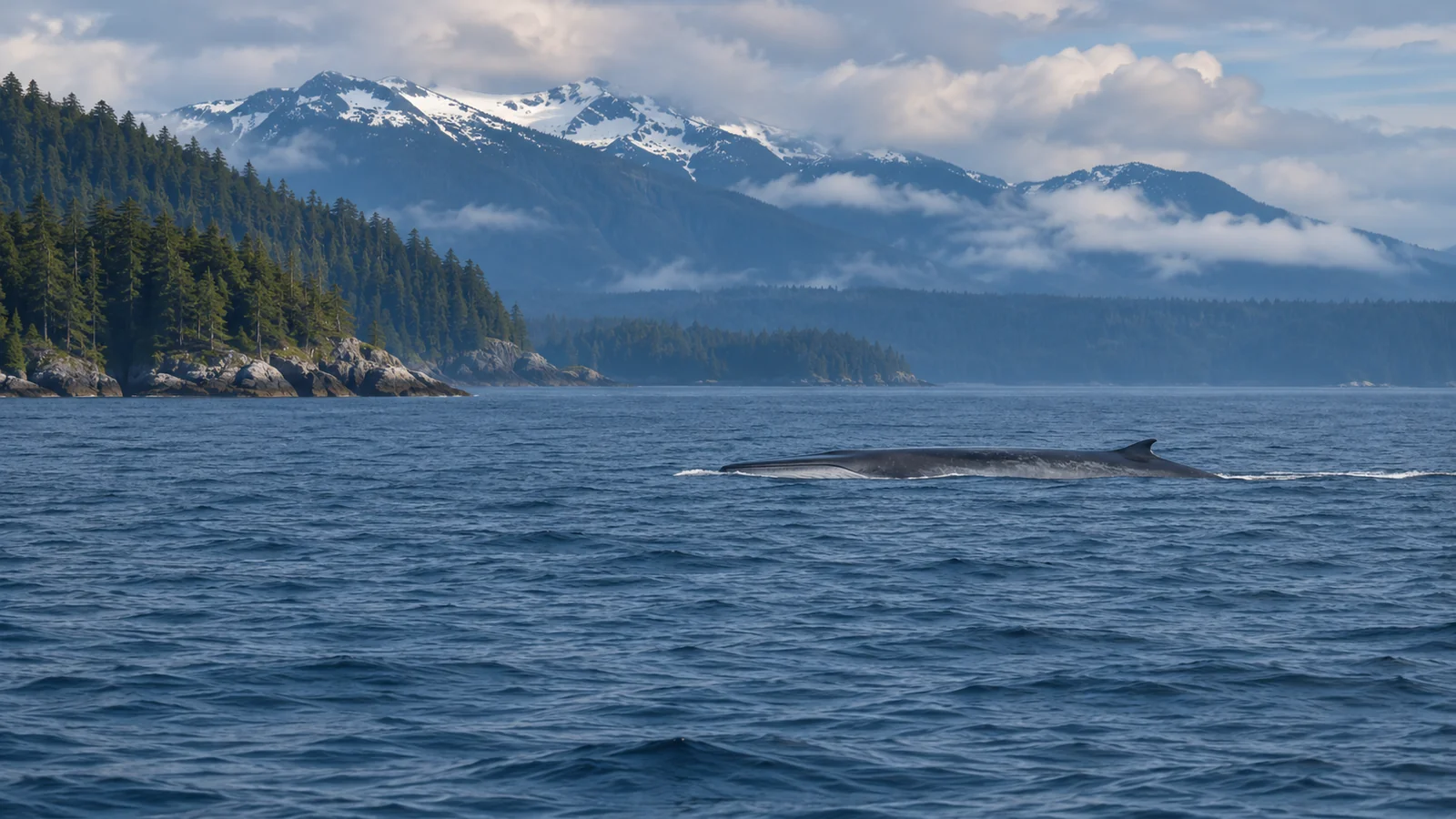
A fin whale has a long, streamlined body, a pointed head and a swept-back dorsal fin set well behind the blowholes. A clear view of its right side may show a pale lower jaw, while the left lower jaw is dark. A humpback usually looks stockier and can show a more pronounced arch as it dives, very long pectoral flippers or flukes raised above the water. Both whales have dorsal fins and can produce prominent blows. Compare the head, back and fin as a sequence before relying on any one feature. COSEWIC assessment of Atlantic and Pacific fin whales NOAA Fisheries humpback whale profile
In coastal British Columbia, a blow can be the first thing you see. Keep the surrounding water in view as the animal rolls. A longer view of its back may show how far the dorsal fin sits behind the head. A different surfacing could show the jaw or the start of a dive. If the whale disappears before those features are visible, the location and the part you saw are still worth recording.
Compare how the back moves through the water
A fin whale’s back can look long and low as it passes through the surface. The blowholes appear first and the dorsal fin follows. The dorsal fin is set far back and typically curves towards the tail or ends in a point. In a good broadside view, you may see a long stretch of back before the fin clears the water. If you first noticed the animal when the fin was already visible, leave the timing of the blow open. Canadian recovery strategy for blue, fin and sei whales COSEWIC fin whale assessment, physical description
A humpback’s dorsal fin can sit on a noticeable raised base. During a dive, the animal can lift and arch the back around the fin. That movement can make the outline look more rounded and give a sense of how the body turns downward. An individual surfacing while travelling may show a lower curve. The shape and size of the dorsal fin also vary among humpbacks. A single curved silhouette is a weaker clue than a view that includes its position on the back and the shape of the surrounding body. DFO cetaceans of British Columbia identification poster
Watch for a broadside angle when you can get one from your current position. A whale moving away can appear shorter because you see the body foreshortened. A wave may hide the middle of the back and make a long whale appear as two dark shapes. The apparent amount of back can also change as the whale arches. Note which way the head and fin pointed and which parts of the animal were visible together.
Why the fin whale’s right jaw is a strong clue
Fin whales are asymmetrically coloured around the head. The right lower jaw is pale or white and the left lower jaw is dark. If the whale presents a clear view of its right side, that pattern can be especially useful. A view of the left side may show only a dark head. A view from directly behind or above may leave both sides hidden. Check which side your image shows before expecting to see the pale area. NOAA Fisheries fin whale species profile
A pale flash beside a whale can have several sources. White water can run along the jaw as it surfaces, light can reflect from the body or part of an underside can appear in a turn. Look at whether the colour stays on the lower jaw as the whale moves. A short sequence can show the edge of the marking more clearly than a still frame. If it is possible to see the same shape in several frames, you have stronger evidence than a single bright line at the surface.
A humpback may show pale areas on a flipper, throat or underside. It also has rounded bumps on the head that can be visible in a close, clear photograph. On a fin whale, the head is comparatively pointed and streamlined. In an ordinary surface view, you may only have the outline of the snout and the position of the blow. Let those clues support one another if visible. There is no need to seek a view of the opposite side by following or approaching the whale. COSEWIC fin whale assessment
What the flippers and tail add
The humpback’s pectoral flippers are notably long and may reach roughly a third of its body length. If one rises as the whale rolls, you may see the long outline and sometimes light and dark markings. The fin whale has a more slender body and smaller flippers in proportion to its length. Those flippers may remain underwater during a typical surfacing. The absence of a visible long flipper tells you little when the whale never rolled far enough to show one. NOAA Fisheries fin whale profile
Humpbacks can raise their flukes at the start of a dive, giving a view of the broad tail and its trailing edge. A fin whale typically dives without raising its flukes above the surface. Watch how much of the rear body you can see as the whale descends. If waves hid the tail, record it as unseen. If you watched the entire sequence and saw the dorsal fin and back slide down without a tail rise, the observation can support other clues to a fin whale. DFO humpback whale catalogue and fluke identification
A raised tail can also reveal that you were watching a separate animal. If two whales surface in the same patch, the first fin you saw might belong to the one that kept travelling while another dived. Use landmarks and time to follow one animal through the sequence. A wide photograph showing both whales can help you place the features. Two sharp close-ups can be harder to interpret if there is no way to tell whether they show the same individual.
Use the blow to find the body
Fin whales often show a tall, narrow blow, while a humpback’s can look broader or bushier. Wind can bend either blow and make it disappear. Distance and the angle from which you see it also affect the shape. A clear view of a tall blow tells you where to look next. It carries less weight than a pale right lower jaw or a clear profile of the back and dorsal fin on the same animal. Mariner’s Guide to Whales, Dolphins and Porpoises of Western Canada NOAA Fisheries whale identification guide
Notice where the blow first appears, then watch the stretch of water behind and around it. A fin whale can expose a long back before its dorsal fin comes up. A humpback may also surface with a delay before the dorsal fin becomes visible. Timing is most useful alongside a view of the shape, fin position and head. If the whale surfaced against a dark shoreline and you could see only the vapour, keep that limitation with your report.
Try the comparison on two brief encounters
In one example, a tall blow appears offshore. A long, relatively low back rolls through the water, and a swept-back fin comes into view well behind the head. On another surfacing you see a pale lower jaw on the whale’s right side. The profile and pigmentation together support a fin whale. If you saw only the blow and the tip of a curved fin, keep the species open. Other rorquals, including sei whales in Canadian Pacific waters, can share some aspects of the long profile.
In another example, a dark back rises in a strong arch and a relatively low dorsal fin shows over a raised base. The flukes follow, and in a later roll a long pectoral flipper comes into view. Those marks give good support for humpback. A single frame of a small hooked dorsal fin would give you much less. Compare what you saw before and after the clearest frame to work out whether the relevant body parts belong to the same sequence.
How to read the clues in a photograph
First check which direction the whale faces. A fin whale’s pale jaw matters most in a view where you can establish the animal’s right side. If the picture shows a whale facing away and much of the head is underwater, the image might still show the dorsal fin well. Compare what is visible with the same part of a reference illustration. A full profile of either species will contain marks your image may never show. Leave those parts open rather than trying to make the entire image match.
Look for the waterline across the body. A bright band that follows the line where the water meets the whale may be reflection or foam. A body marking should move with the body through the sequence. In a clear shot, compare where the pale area begins and whether it remains on the lower jaw while the head turns. Keep the unedited original as well as any cropped or brightened copy. Colour and contrast can look different after an adjustment, particularly in a dim frame taken against bright water.
Why size and speed are difficult to estimate
Fin whales can grow larger than humpbacks, and their long, narrow outline can be striking in a good view. From shore, a distant fin whale can look smaller than a humpback closer to you. You may only see one section of the back at a time, and a whale angled away appears shorter than one crossing in front of you. Use the apparent proportions only when the viewing angle gives you a reasonable basis for comparison. NOAA Fisheries humpback whale profile
An apparent burst of speed can also reflect the boat’s movement or a change in viewing angle. Record the direction between surfacings using a fixed point when possible. The route tells you how the animal moved across your view without requiring a speed estimate. If the whale comes into view again in calmer water, use that opportunity to compare the back, the jaw and the point at which the fin appears. A second surfacing can show whether the same details stay visible as the angle changes.
Keep the habitat and the identification in context
Both species occur in British Columbia’s Pacific waters. A map of fin whale sightings based on offshore and inshore surveys covers a broader area than the water visible near Campbell River. A humpback may also use open water or come into the channels. Where you saw the whale can help a reviewer place the encounter. The body details and behaviour determine how confident you can be in the identification. DFO 2018 survey of cetaceans in Canadian Pacific waters
Write down the time, general place, direction of travel and which side or part of the whale you could see. If the best frame shows the back and fin but cuts off the head, note that before checking the jaw colour. Eagle Eye Adventures’ guide to marine wildlife around Campbell River introduces other species you may see while watching the same coast. Observe from a safe public viewpoint or follow crew directions on a vessel. If you report the sighting, include images and any uncertainty rather than choosing a species on the basis of the first blow. DFO marine mammal sighting guidance
If the whale surfaces only once, record the features you actually saw and leave the identification open.
If the whale surfaces only once, record the features you actually saw and leave the identification open.